Overview
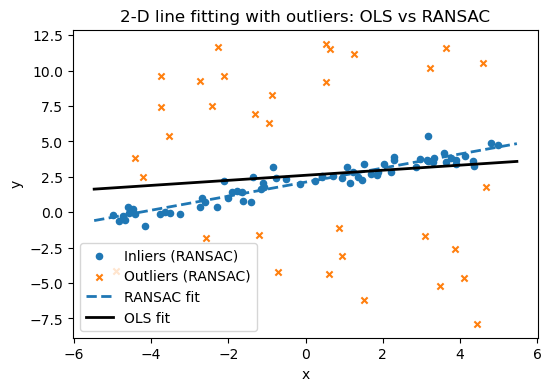
Random Sample Consensus (RANSAC) is a robust estimator for fitting models in the presence of outliers. At each iteration, it samples a minimal subset, fits a candidate model, scores inliers under a residual threshold, and retains the model with the strongest consensus. Compared with ordinary least squares (OLS), it remains stable even when outliers are abundant.
RANSAC Intuition
We use RANSAC for:
- outlier detection through robust line and plane fitting;
- regularizing irregular time series before downstream embedding.
Outlier Detection (Lyngen)
Time-Series Line Fitting (point-wise)
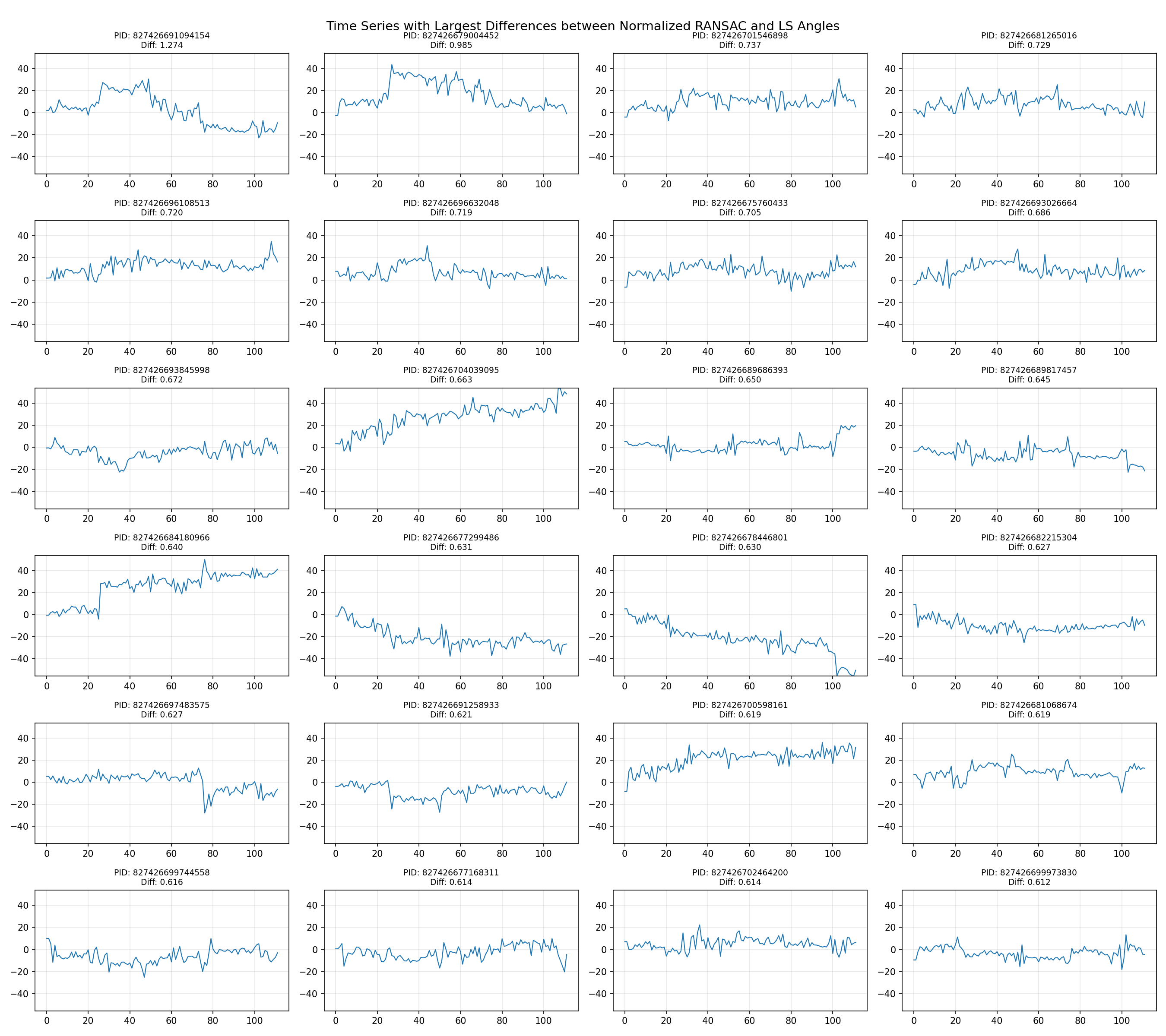
For each time series $y(t)$, we fit a robust line $y = m \cdot t + c$. Timestamps with residuals
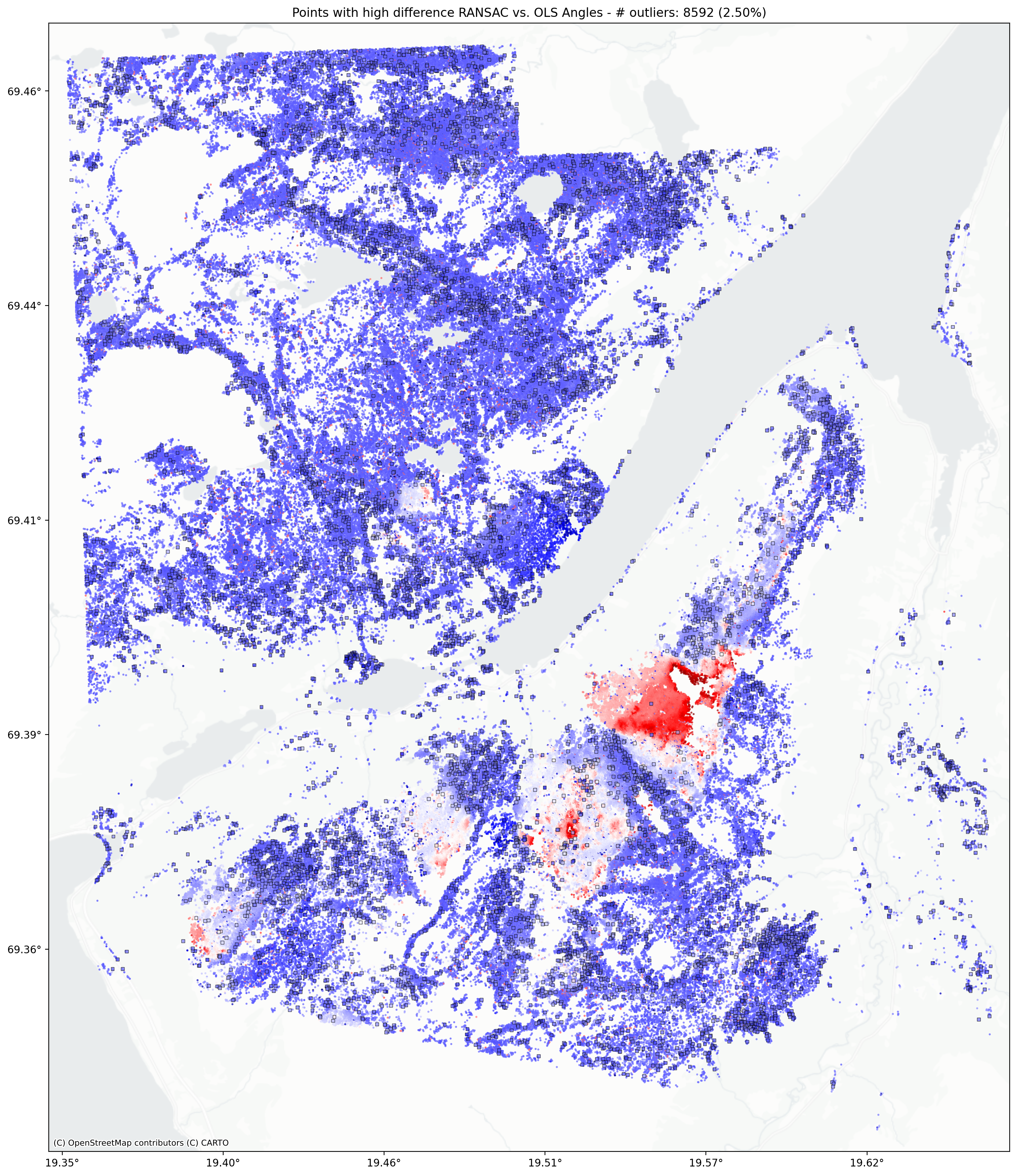
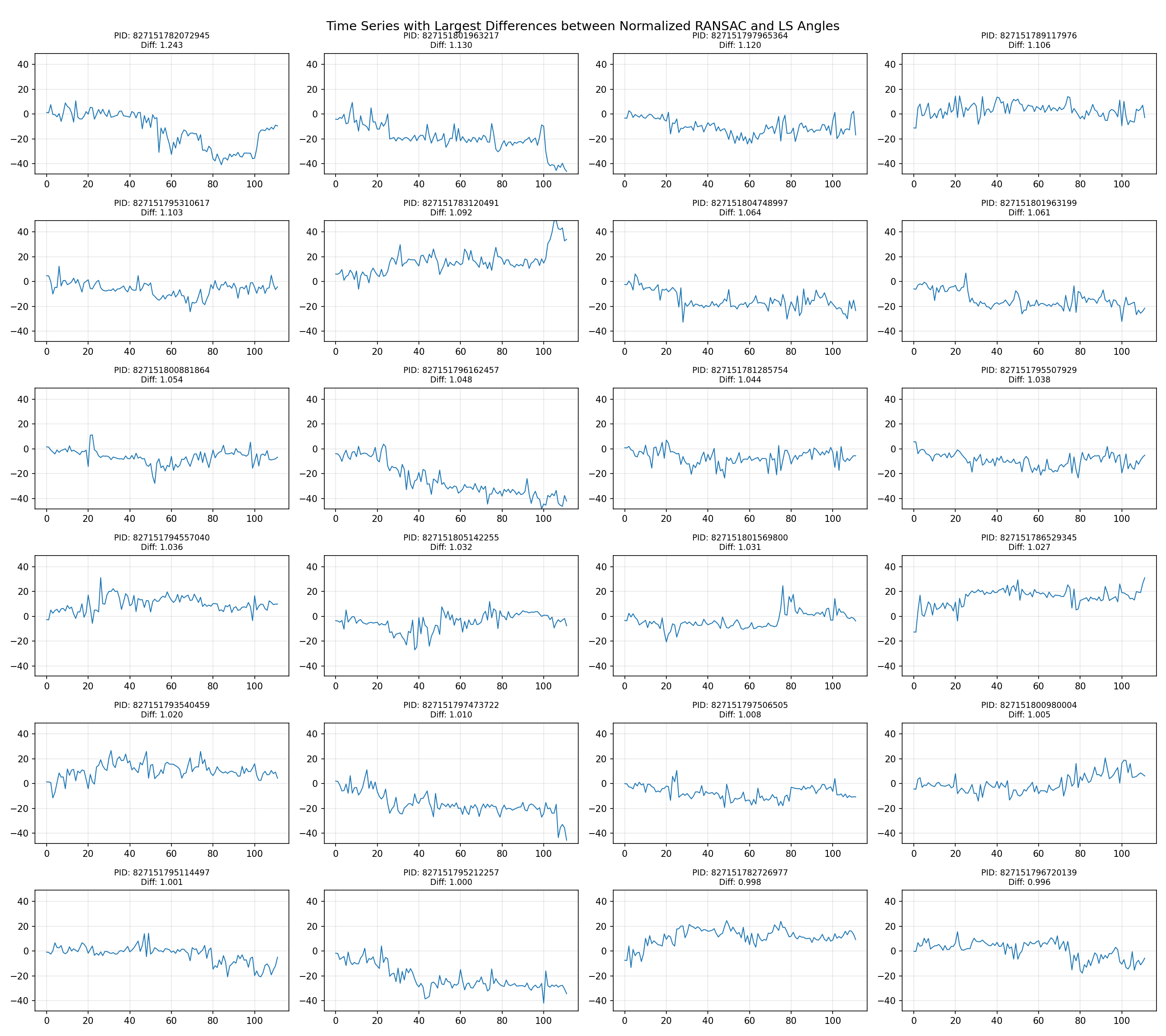
\[|y - (m \cdot t + c)| \leq \tau\]are classified as inliers. Large disagreements between RANSAC and OLS identify unstable or noisy series.
Lyngen Point-Wise Outliers
Spatial Plane Fitting (global)
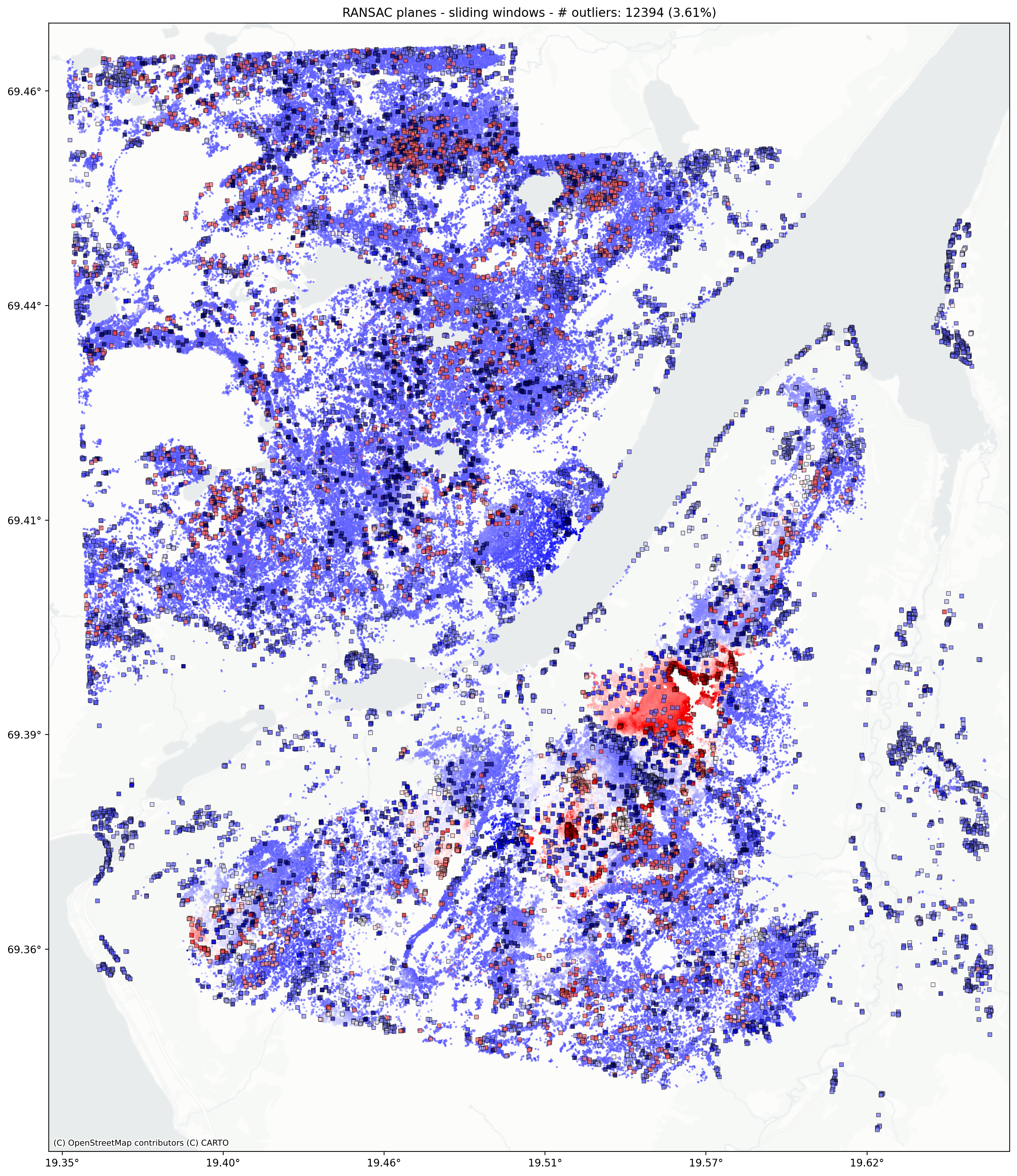
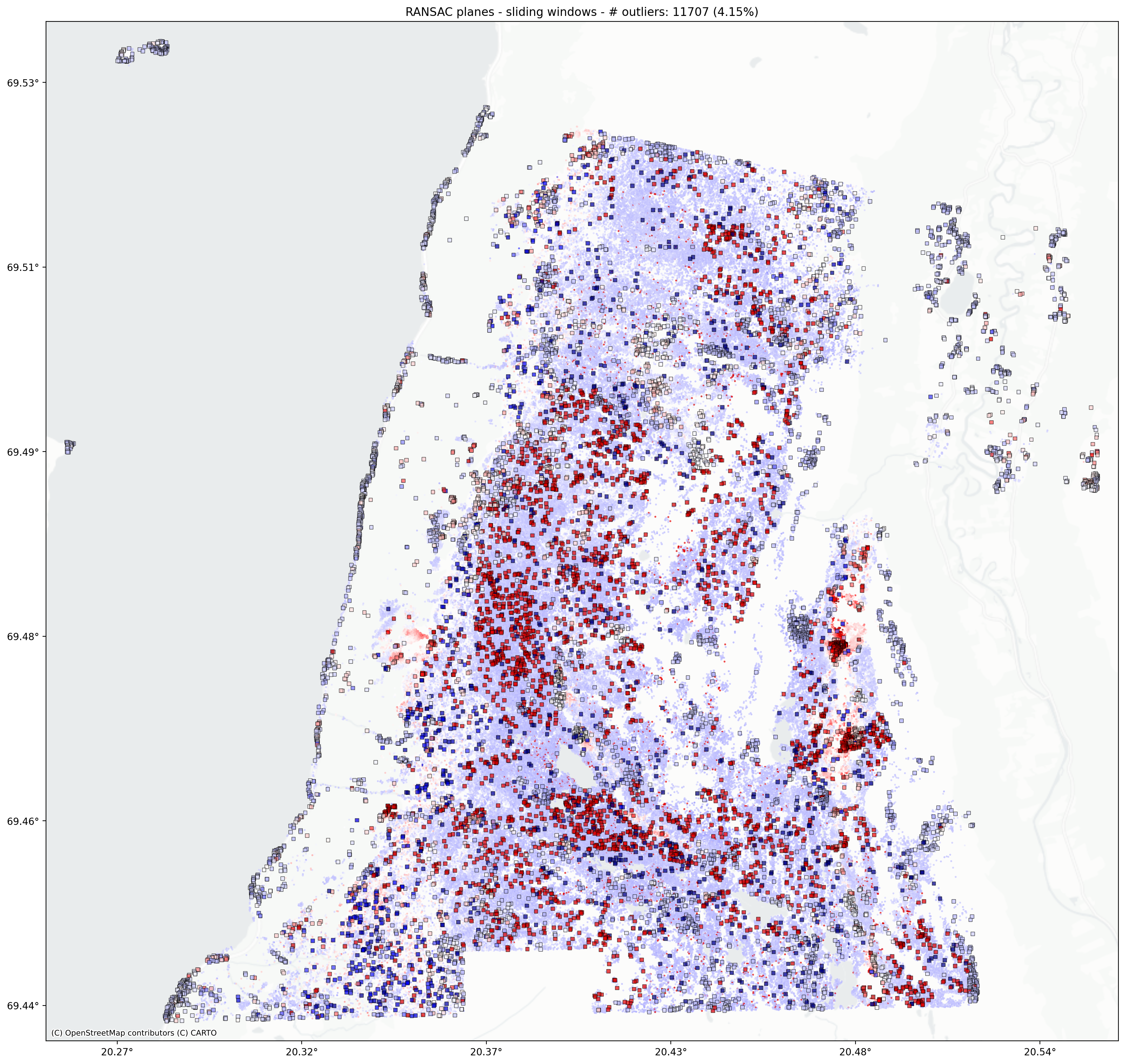
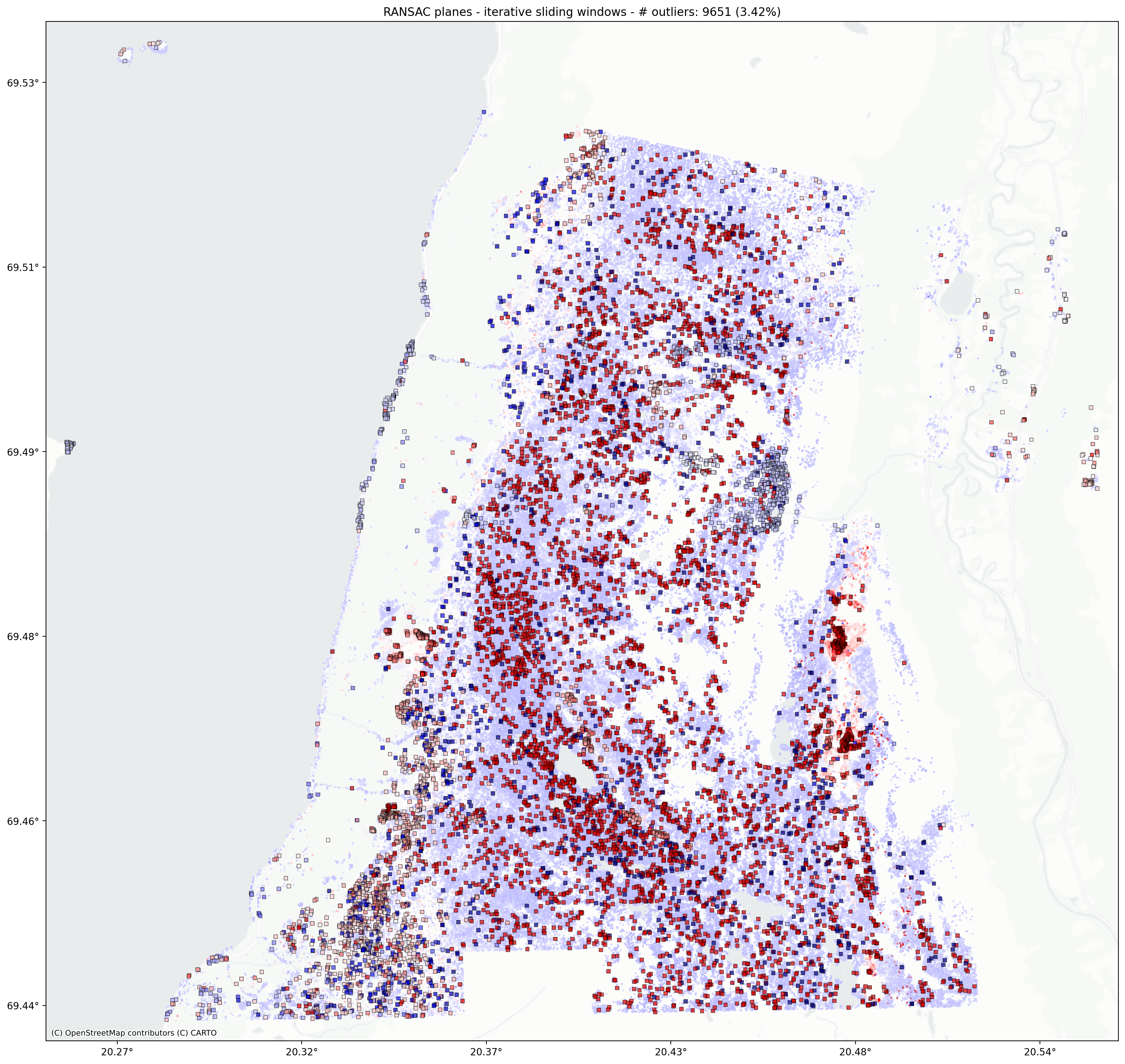
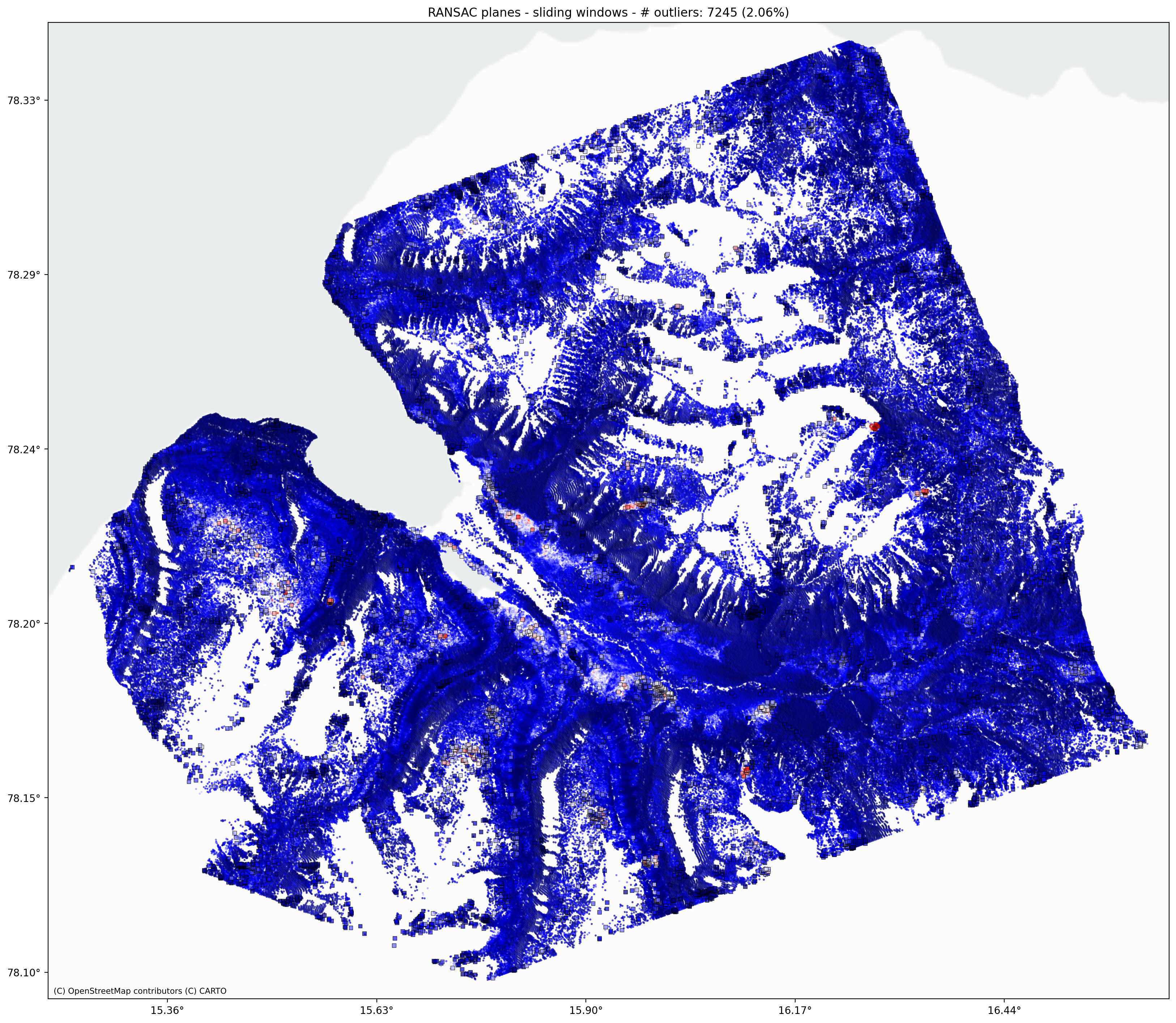
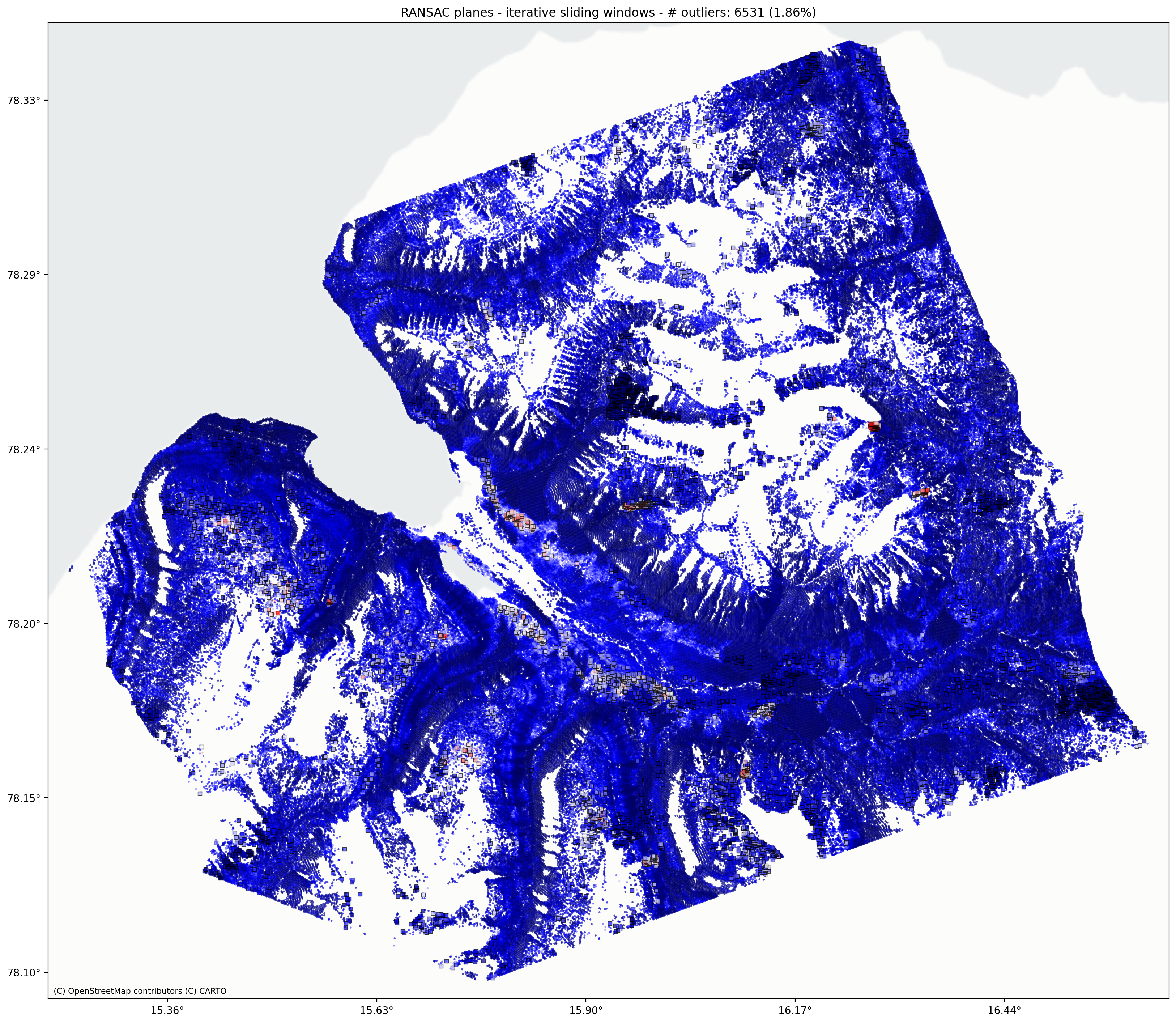
We then fit local planes $z = a \cdot x + b \cdot y + c$, where $z$ is the per-point RANSAC slope and $(x, y)$ are geographic coordinates. Using overlapping windows yields local consensus scores and reveals spatially inconsistent points.
Lyngen Sliding-Window Sensitivity
.png)
.png)
.png)
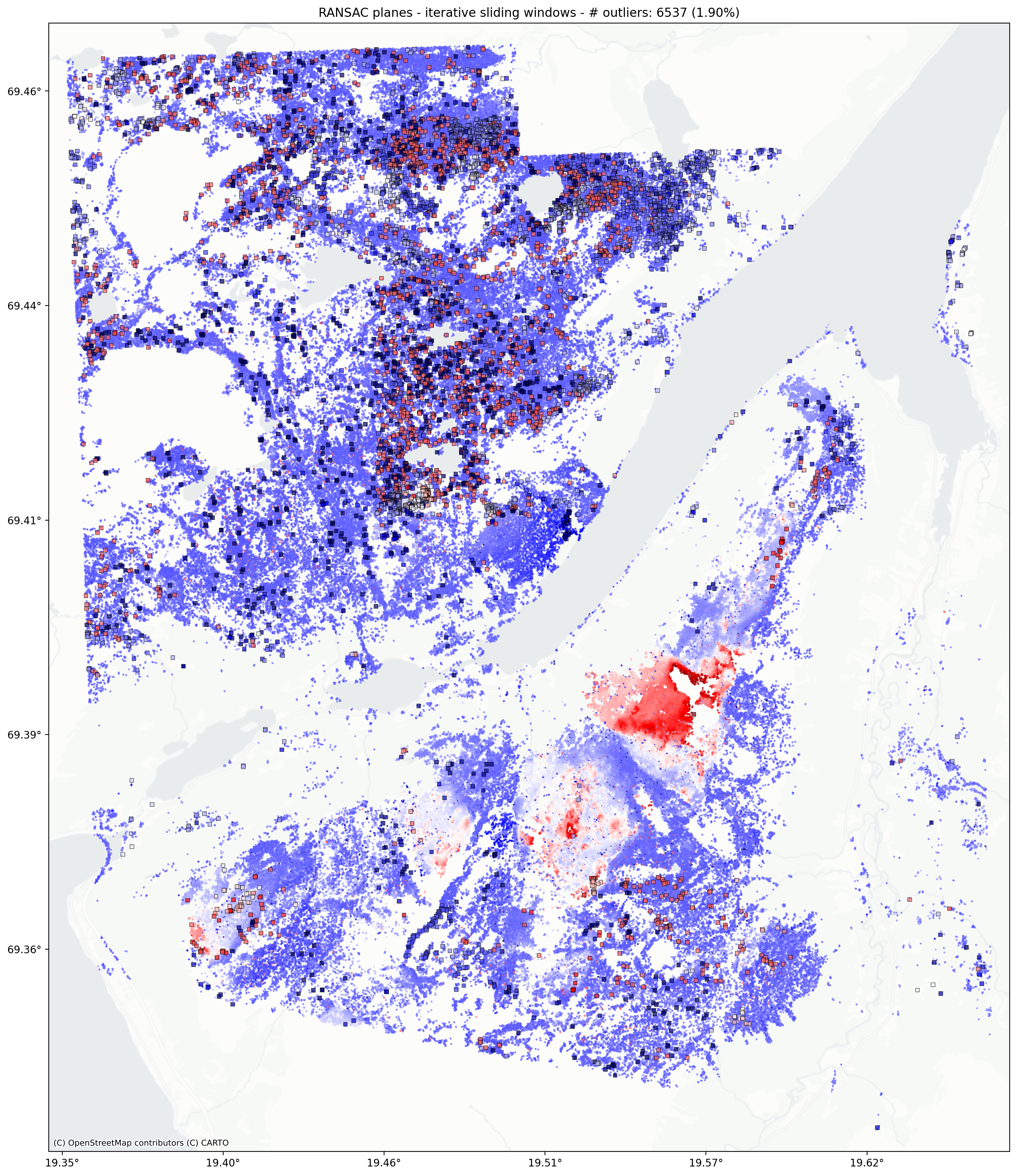
To reduce window-size sensitivity, we run an iterative strategy with progressively larger tiles and looser consensus thresholds, peeling inliers at each step until no stable plane remains.
Lyngen Iterative Strategy
Other Results
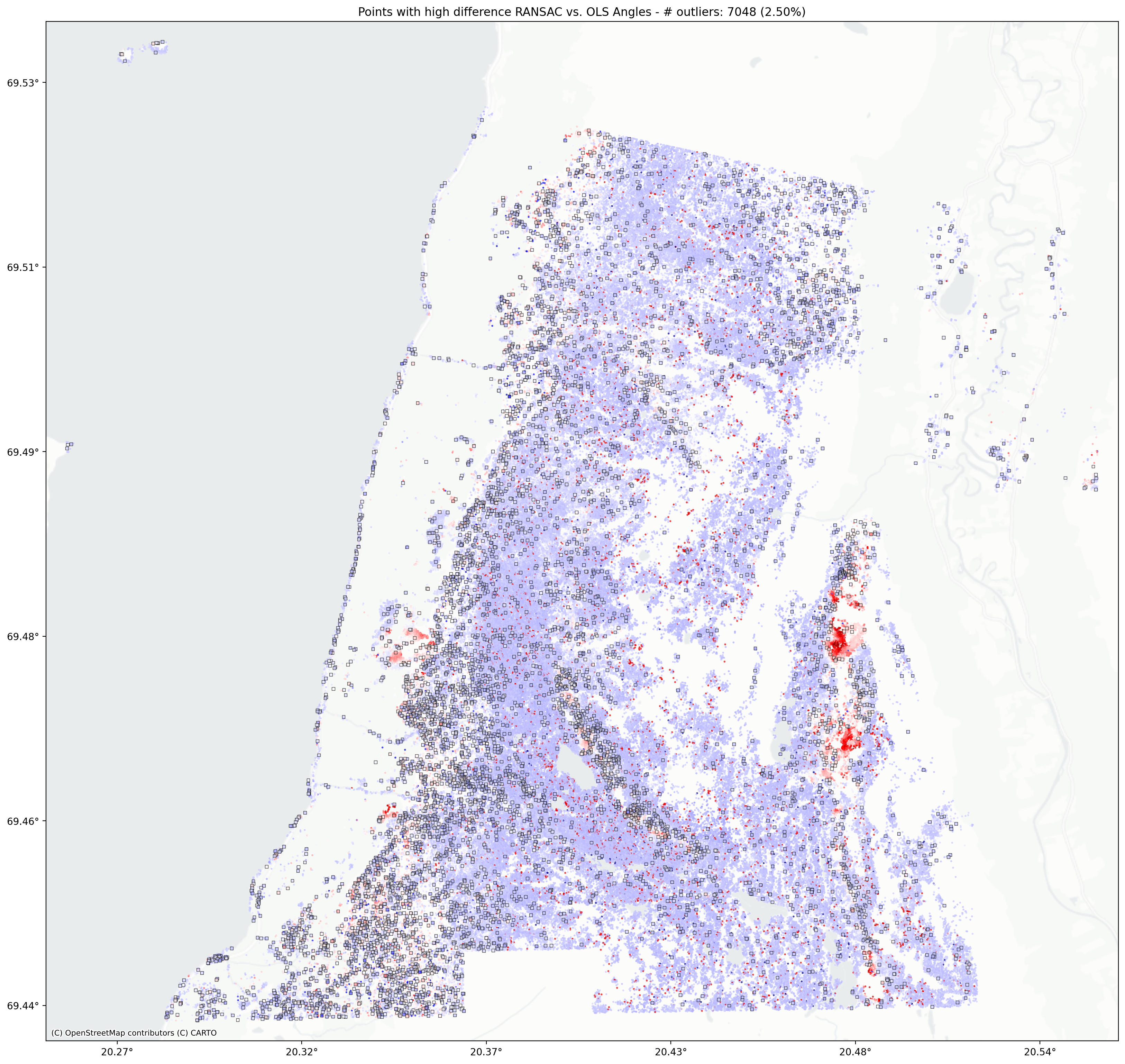
Nordnes
Svalbard
Resampling Irregular Time Series
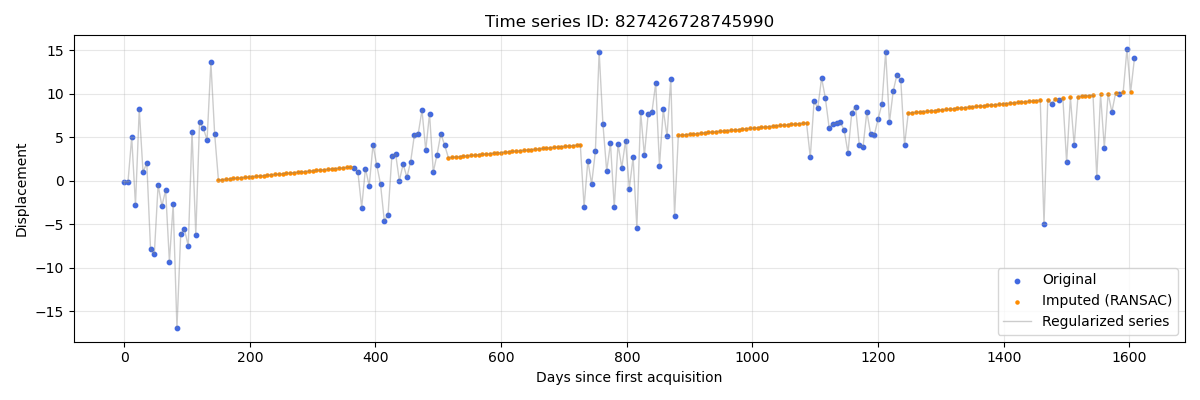
Before Reservoir Computing embeddings, irregular series are transformed to a regular grid using the robust RANSAC trend. Observed values are preserved at acquisition timestamps, while missing timestamps are filled with the fitted trend.
Procedure:
- Fit RANSAC on $(t, y)$ for each series to estimate slope $m$ and intercept $c$.
- Build a regular grid
t_regover[t_min, t_max]. - Fill missing values with $\hat{y}(t) = m \cdot t + c$ and keep observed values where available.
Time-Series Regularization